🔘 IN GR TR AL OF CO xxxxx ✅ 2️⃣ 3️⃣ 4️⃣ 5️⃣ 6️⃣ 7️⃣ 8️⃣ xxxxx AN RP IV alia
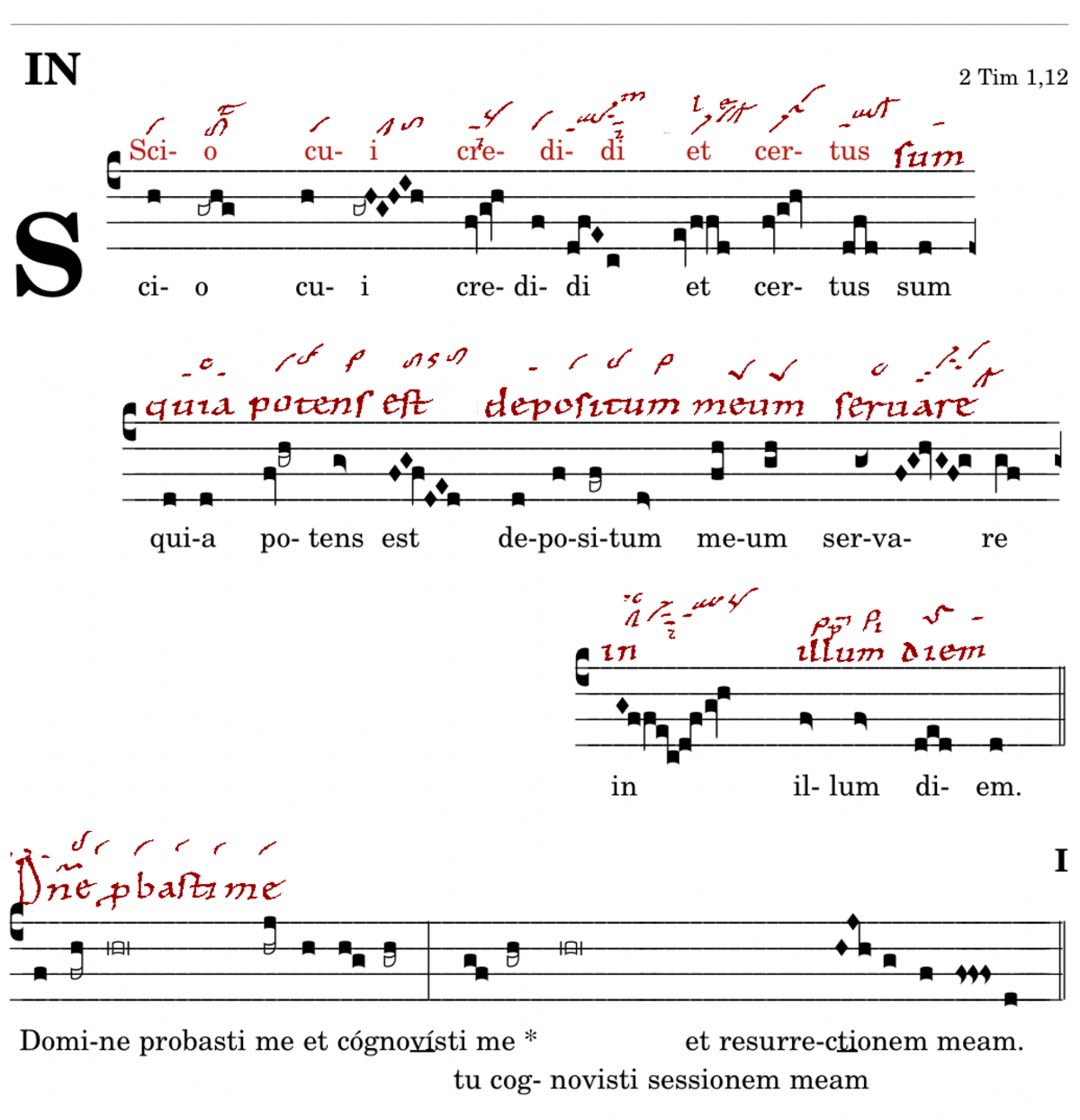
0144 IN Scio cui credidiModus 1
0143 ⟽ IN 1 ⟾ 0151 xxx ⏹️xxx GT 535 - GN 2/229 - BzG 52/162️⃣ AB - EFF
 Variierende Wiederholung ist das Prinzip dieses Introitus. Kern ist der nicht kurrente Scandicus (nkSca) „fa-sol-la“. Wenn der folgende Ton „fa“ ist (1,5), so kadenziert der Cento zum „re“. Ist der folgende Ton „sol“ (3,4), kadenziert er zum „fa“.
1 „Scio cui“ Zwei Zweisilber, abgefangen mit TrcFIN und FML circulatio, leiten den ersten Cento ein. Schluss bildet ein PesSbp (12-4) zu „do“, ergo 'colon'.
2 Ein amplifizierter Trc „mi-fa-re“ leitet ein, das Ende ist ein TrcFIN zur Terz.
3 Dieser Cento endet mit der CAD TrcTrc, zwei praetonische Silben „quia“ stehen vor dem Akzent (Virga mit aufgesetztem kurrentem AkzentPes).
4 Bei „mein“ ist der nkSca „fa-sol-la“ zur FML quia verwandelt in Bezug zum vorherigen Cento. CAD mega D schließt auf „fa“ ab. Modern gesprochen verwenden gregorianische Introitus gern die 'parallele Dur-Tonart in der Mitte dorischer Kompositionen (d-mol; F-Dur), hier vor dem Schlusscento.
5 der Sca „fa-sol-la ist hier der Schluss einer kat.anabasis-Bewegung, die den Tenor „fa“ wieder zum „re“ absenkt. Die beiden Cephalici „il-lum“ sind klanglich recht bescheiden 'parvulum, inferius' vor dem abschließenden TrcFSE (nkTrc auf der vorletzten Silbe).
Der gesamte Introitus, alle fünf Centones, ist um die fünf Sca „fa-sol-la“ gruppiert, ist auf sie bezogen.
PS „depo-si-tum“; wäre die VStr ein Halbtonpes, müsste er hier eingesetzt sein!
Ich weiß wirklich, an wen ich glaube / und ich bin überzeugt,
dass er mächtig ist /
das mir anvertraute Gut zu bewahren
bis zu jenem Tag.

I truly know in whom I believe / and I am convinced
that he is mighty / to preserve the good entrusted to me
until that day.
Varied repetition is the principle behind this introit. Its core is the non-current scandicus (nkSca) ‘fa-sol-la’. If the following note is ‘fa’ (1,5), the cento cadences to ‘re’. If the following note is “sol” (3,4), it cadences to ‘fa’.
1 ‘Scio cui’ Two disyllables, intercepted with TrcFIN and FML circulatio, introduce the first cento. The conclusion is a PesSbp (12-4) to ‘do’, ergo “colon”.
2 An amplified Trc ‘mi.fa-re’ introduces, the end is a TrcFIN to the third.
3 This cento ends with the CAD TrcTrc, two praetonic syllables ‘quia’ precede the accent (virga with a superimposed cursive accent Pes).
4 In ‘mein’, the nkSca ‘fa-sol-la’ is transformed into FML quia in relation to the previous cento. CAD mega D concludes on ‘fa’. In modern terms, Gregorian introits often use the 'parallel major key in the middle of Dorian compositions (D minor; F major), here before the final cento.
5 The Sca ‘fa-sol-la’ is here the conclusion of a cat.anabasis movement that lowers the tenor ‘fa’ back to “re”. The two Cephalici ‘il-lum’ are quite modest in sound “parvulum, inferius” before the concluding TrcFSE (nkTrc on the penultimate syllable).
The entire introitus, all five centones, is grouped around the five Sca ‘fa-sol-la’ and relates to them.
PS ‘depo-si-tum’; if the VStr were a semitone pes, it would have to be used here!