🔘 IN GR TR AL OF CO xxxxx 1️⃣ ✅ 3️⃣ 4️⃣ 5️⃣ 6️⃣ 7️⃣ 8️⃣ xxxxx AN RP IV alia
0051 IN Ex ore infantiumModus 2
0040 ⟽ IN 2 ⟾ 0060 xxx ⏹️ xxx GT 638 - GN 2/316 - BzG 63/312️⃣ AB - EF xxx 1️⃣ AI - YF
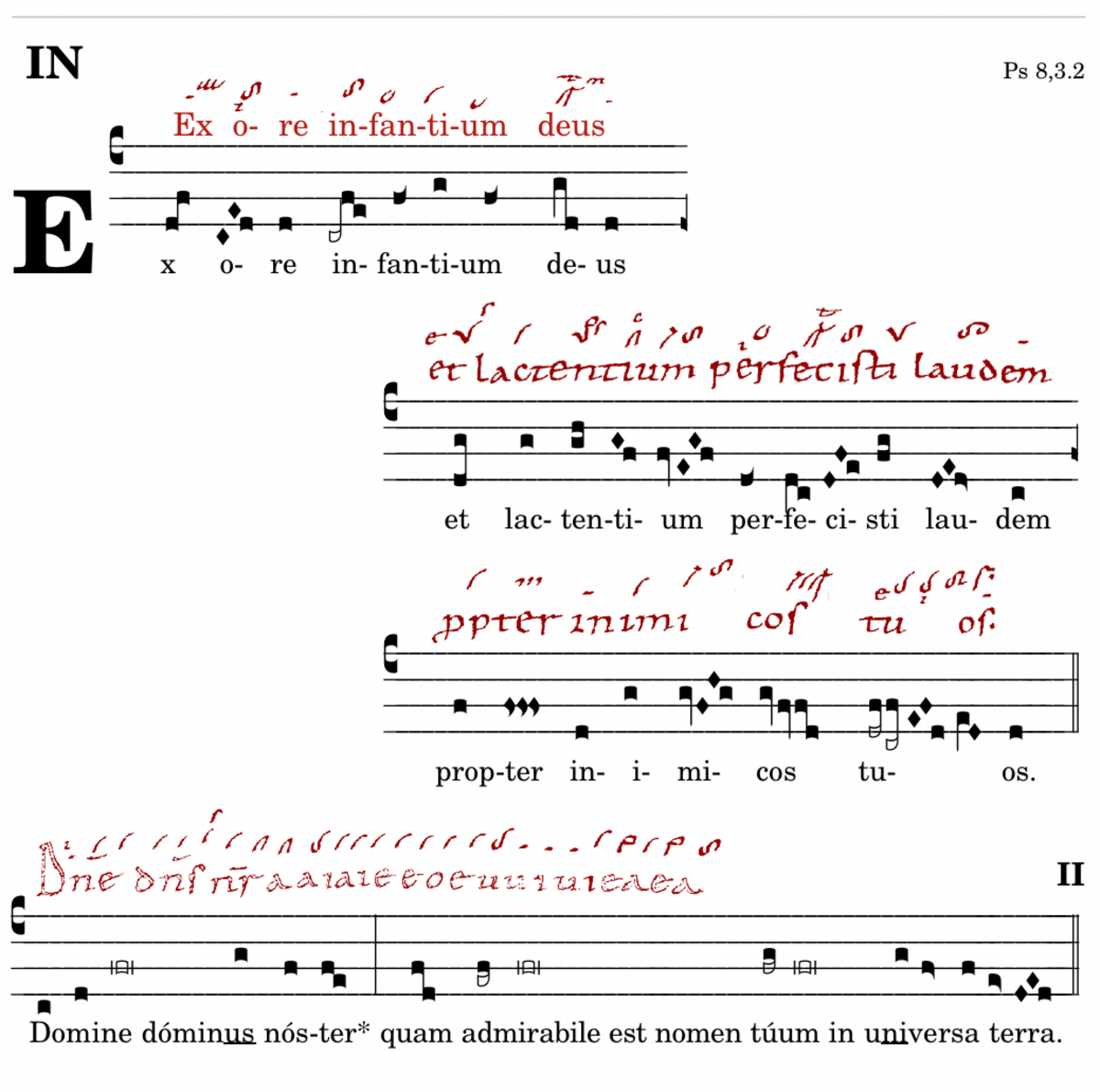
• 2INC ad3 „Ex ore“ beginnt mit dem Terzpes und setzt fort mit einem TrcGRAV, der das Schlüssel-Element dieses IN ist.
• FLM pot
• TrcINT „infantium deus“ Die Formel müsste eigentlich die Akzentsilbe zum „sol“ führen, der Epiphonus verhindert das. So hebt sich das Wort „infántium“ über die Formel hinweg und die Betonung liegt bei „déus“.
• 1INC ad4 „et lacténtium“, Tenorebene „sol“. Auch das Wort „inimicos“ in der 2. Periode wird zur Quart angehoben.
• FA-RE „perfecisti laudem“ Beginnend auf der Finalis „re“ endet der Cento auf „do“: Colon. Er erinnert einerseits mit der Clv an 1INC Clv, bricht aber ab. Der Pes „fa-sol“ erinnert an den ClmRes, der üblicherweise den Akzent auf der Finalis vorbereitet, in diesem Fall auf den Akzent „láudem“ (TrcACC).
 • 2TER „propter inimicos tuos“ Sehr individueller Melodieverlauf. Bei
„inimi-cos tu-os“ ist deutlich ein Unterschied zwischen den beiden Traditionen zu sehen:
zum „do“ 🍏 frOc, oder zum „re“ 🍎 frOr.
Wichtig ist es, den Übergang vom vorletzten zum letzten Wort als Einheit zu sehen:
„do“ Bv 33/34 (Mod, Mp)
„re“ Kl (Zw). Entscheidend sind die beiden litterae auf denn Pedes “tu-os„ in E, der zweite Pes beginnt 'inferius', der erste Pes ist mit der Silbe zuvor 'equaliter' verbunden. Dem kann nur Kl entsprechen. Ch ist für den ersten Pes 'equaliter' zu lesen.
A + Y sind ein Mischtyp. Der erste Pes ist zwar 'equaliter', wenn zuvor ein „do“, aber der zweite Pes ist nicht 'inferius'.
Wesentlich für diesen IN ist aber der TrcGRAV, der Trc der mit Terz-Bewegung beginnt. Er drückt eine gewisse Wichtigkeit, Gewichtigkeit aus. Viermal wird eingesetzt, zweimal am Beginn der Perioden, zweimal am Ende und das in aufsteigender Folge: 1. Periode zum „re“ und „fa“, 2. Periode zum „mi“ und „sol“.
In den Schlüssen ist dem Trc ein nkPes vorgesetzte, die Neume wird so zum PrrFlx anfangsartikuliert (1–4).
Bemerkenswert ist auch das häufige Auftreten der Quart-Spannung „sol-re“ bzw. „re-sol“ “de-us et„, „perfecis-ti lau-dem“, “ini-mi-cos„. Bei der Silbe “-cos„ ist die Quart zum viertonigen nkClm ausgeweitet. Aber auch die Quartspannung „fa-do“ tritt auf: “Ex o-re„, “tu-os„.
Aus dem / Munde von Kindern, Gott / und von Säuglingen /
hast du dir Lob bereitet / um deiner Feinde willen.

From the mouths / of children, God / and from infants /
you have prepared praise for yourself / for the sake of your enemies.
• 2INC ad3 ‘Ex ore’ begins with the Terzpes and continues with a TrcGRAV, which is the key element of this IN.
• FLM pot
• TrcINT ‘infantium deus’ The formula should actually lead the stressed syllable to ‘sol’, but the epiphony prevents this. Thus, the word ‘infántium’ stands out from the formula and the stress falls on ‘déus’.
• 1INC ad4 ‘et lacténtium“, tenor level “sol”. The word ’inimicos“ in the second phrase is also raised to a fourth.
• FA-RE ‘perfecisti laudem’ Beginning on the finalis “re”, the cento ends on ‘do’: colon. On the one hand, it recalls 1INC Clv with the Clv, but breaks off. The Pes ‘fa-sol’ is reminiscent of the ClmRes, which usually prepares the accent on the finalis; in this case, on the accent ‘láudem’ (TrcACC).
• 2TER ‘propter inimicos tuos’ A very distinctive melodic progression. In
‘inimi-cos tu-os’ a clear difference between the two traditions can be seen:
to the “do” 🍏 frOc, or to the ‘re’ 🍎 frOr.
It is important to view the transition from the penultimate to the final word as a single unit:
‘do’ Bv 33/34 (Mod, Mp)
“re” Kl (Zw). The two litterae on the pes ‘tu-os’ in E are decisive; the second pes begins “inferius”, whilst the first pes is linked “equaliter” to the preceding syllable. Only Kl can correspond to this. Ch is to be read as “equaliter” for the first pes.
A + Y are a mixed type. Although the first pes is “equaliter” when preceded by a ‘do’, the second pes is not “inferius”.
However, what is essential for this IN is the TrcGRAV, the Trc that begins with a third movement. It expresses a certain importance, gravitas. It is used four times, twice at the beginning of the periods, twice at the end, and in ascending order: 1st period to ‘re’ and ‘fa’, 2nd period to ‘mi’ and ‘sol’.
In the cadences, the Trc is preceded by an nkPes; the neume is thus articulated as a PrrFlx at the beginning (1–4).
Also noteworthy is the frequent occurrence of the ‘sol-re’ or ‘re-sol’ fourth interval: ‘de-us et’, ‘perfecis-ti lau-dem’, ‘ini-mi-cos’. In the syllable ‘-cos’, the fourth is extended to the four-note nkClm. But the fourth interval ‘fa-do’ also occurs: ‘Ex o-re’, ‘tu-os’.