🔘 IN GR TR AL OF CO xxxxx ✅ 2️⃣ 3️⃣ 4️⃣ 5️⃣ 6️⃣ 7️⃣ 8️⃣ xxxxx AN RP IV alia
0297 AL Beatus vir qui suffertModus 1
3569 ⟽ AL 1 ⟾ 03051410 ⟽ AL 1 alii ⟾ 0328xxx ⏹️xxxGT 511 - GN 2/210 - BzG 61/29 - SX ……
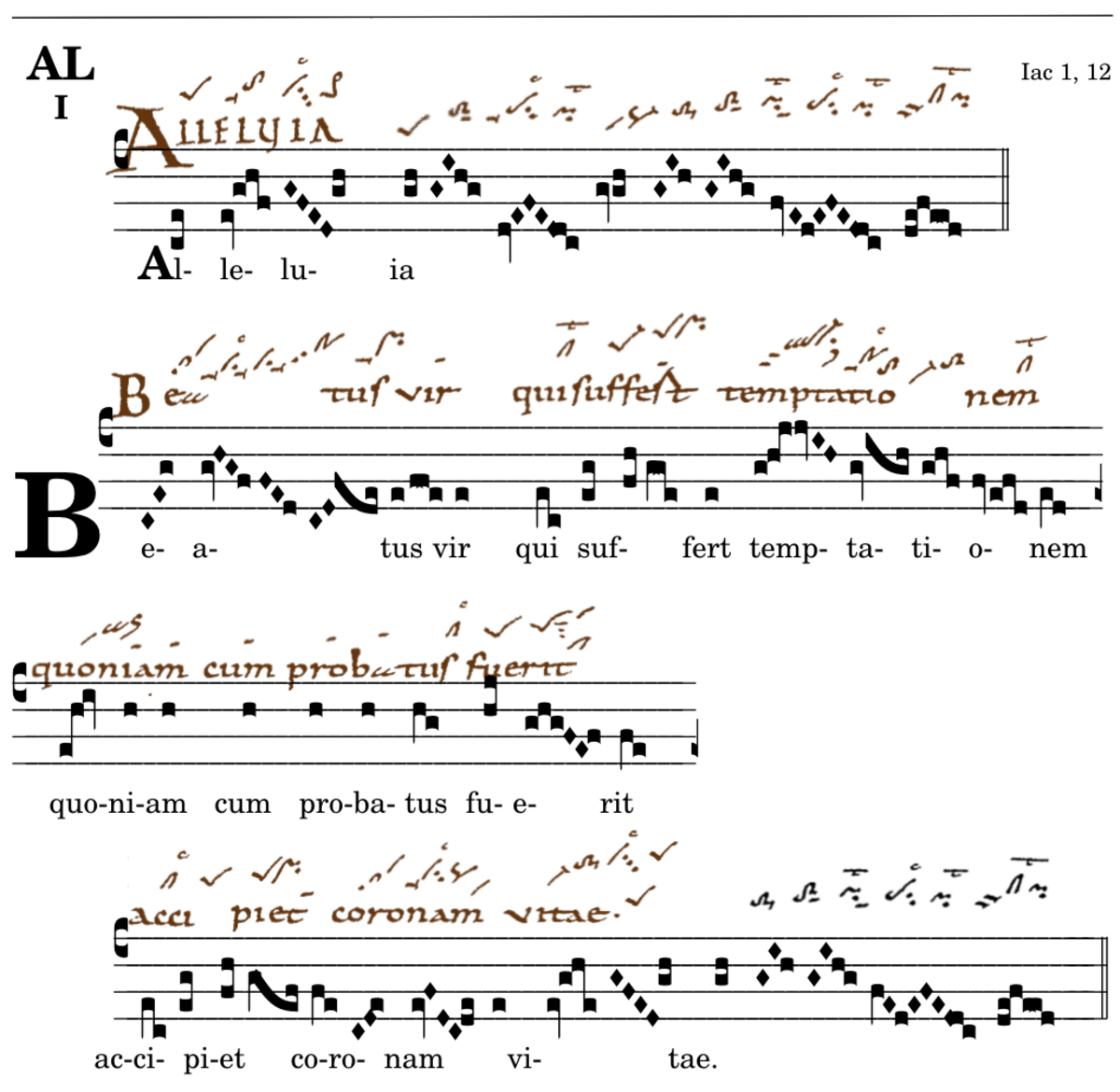
Dieses AL ist erst um 900 komponiert und kommt aus der traditio frOr. Es steht noch nicht im SX, aber doch bereits im C. Für die melodische Restitution ist der Quart-Aufstieg in der Silbe „alle-lu-ia“ wichtig „re-sol-la“. Er sollte sich im Iubilus selbst wiederholen. Das 'levare' in E und Bam spricht aber eher für das „mi-sol-la“ von A und Kl, das durch das unisonische „do“ zuvor der anderen Quellen zusätzlich bestätigt ist.
„quo-niam“ Quilisma mit appliziertem Oriscus hebt den Zielton über die Reztationsebene „la“ zum „si“. Eine verminderte Quint „sa“ ist hier absolut unmöglich. Das in Fragen zum „si“ oder „sa“ aufschlussreiche Kl entzieht sich hier einer Stellungnahme durch bloßen Sca „fa-sol-la“. Das „si“ bei „quo-niam“ steht darüber hinaus in Relation zum „do“ in „fu-erit“. Die
Repetenda verkürzt den Iubilus!
Die Texte „qui suffert“ und „accipiet“ sind parallel komponiert.
V. Selig der Mann, der (in der) Versuchung standhält (erleidet).
Denn, wenn er sich bewährt hat / wird er die Krone des Lebens erhalten.

V. Blessed is the man who endures temptation.
For when he has proved himself, he will receive the crown of life.
This AL was not composed until around 900 and originates from the traditio frOr. It does not yet appear in the SX, but is already present in the C. For the melodic reconstruction, the ascending fourth in the syllable ‘alle-lu-ia’ is significant: ‘re-sol-la’. It should be repeated within the Iubilus itself. However, the ‘levare’ in E and Bam suggests rather the ‘mi-sol-la’ of A and Kl, which is further confirmed by the unison ‘do’ preceding it in the other sources.
“quo-niam” Quilisma with an applied Oriscus raises the target note above the restitution level “la” to “si”. A diminished fifth “sa” is absolutely impossible here. The Kl, which is revealing in questions regarding “si” or “sa”, eludes comment here due to the mere Sca “fa-sol-la”. Furthermore, the “si” in “quo-niam” stands in relation to the “do” in “fu-erit”. The
Repetenda shortens the Iubilus!
The texts „qui suffert“ and „accipiet“are composed in parallel.