🔘 IN GR TR AL OF CO xxxxx ✅ 2️⃣ 3️⃣ 4️⃣ 5️⃣ 6️⃣ 7️⃣ 8️⃣ xxxxx AN RP IV alia
1010 OF Domine ad adiuvandum me V1Modus 6
OF – V1 xxx ⏹️ xxx OT 42 - ON xx - BzG 762/12Dieses Offertorium bietet in zwölf Handschriften sechs Textvarianten an. Wir entscheiden uns für die St.Galler Tradition (auch Monza 9.Jh!), den kürzesten Text. Offenbar war der jüngeren Tradition der Text zu kurz. MR schreibt die Texte von Mp und Ch (a.m.!) ineinander, neumiert allerdings nur den Text von Mp.
| E+Kl+Mo | Domine… confundantur omnes | adversantes | mihi. | 1 | ||
| Bv | Domine… confundantur omnes | adversus me | cogitantes | vana. | 1 | |
| A+Y+Zt | Domine… confundantur omnes | qui cogitant | servis tuis | mala. | 1 | |
| Mod+Ang | Domine… confundantur omnes | adversum me | qui cogitant | servis tuis | mala. | 6 |
| Ch a.m. | Domine… confundantur omnes | adversum me | qui cogitant | mihi | mala. | - |
| Mp | Domine… confundantur omnes | qui cogitant | mihi | mala. | 6 | |
| MR | Domine… confundantur omnes | qui cogitant | mala. | - |
Das Offertorium steht zwischen 6. und 1.Modus. Das Stück beginnt im Tonraum des 6.Modus fa-la-do mit „fa-la-sa“. Kl korrigiert zum Typusincipit des PR auth „re-la-sa“. Bv legt das Incipit „Domine ad adiuvandum“ einen Ton tiefer und schafft so einen Protus von der Quart. Kl, Bv und Zt den das Offertorium auf „re“: Protus. A, Y, Mod, Mp enden auf „fa“: Tritus. A setzt mit dem Pes „fa-sol“ eine Weiterführung (Doppelpunkt) auf den Vers hin: „qui cogitant servis tuis mala: Exspectans…dominum“.
Der Vers ist, vom Beginn abgesehen, den Bv gleich um eine Terz verschiebt, reiner Protus authenticus. Die Schlussneume „re-fa-re-fa“ verhindert ein Verweilen auf den „faeces“ und treibt weiter: „confundentur omnes qui…“. Der etwas drastische Text schickt sich wenig zur pastoralen Grundstimmung des 6.Modus. Wir ordnen das OF dem 1.Modus zu.
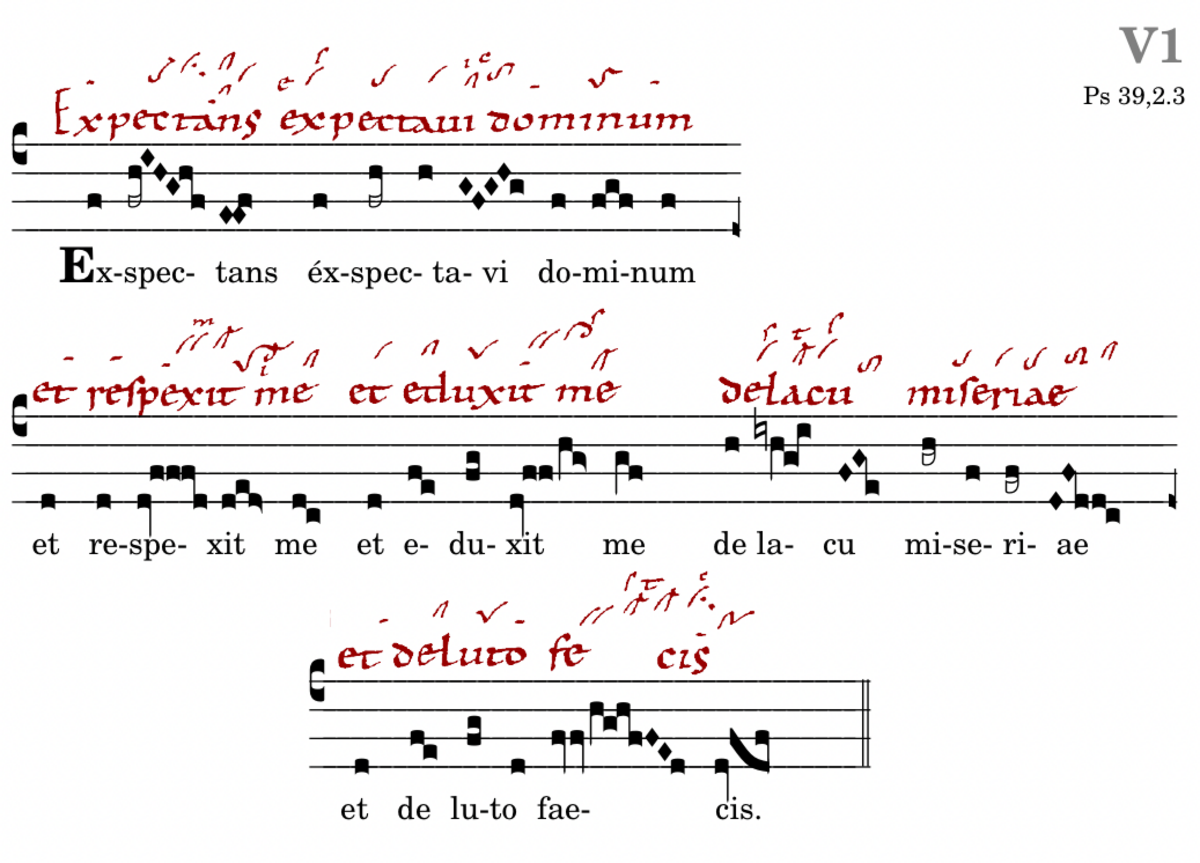
„de la-cu“ Zum „si“, Kl ad „do“, reine Quint zum „mi“ am Ende des Wortes. Wortausdeutung 'Grube des Elends'.
V1. Ich harrte, ja harrte des Herrn /
und er hatte acht auf mich.
Und er führte mich heraus
aus der Grube des Elends / und aus dem schmutzigen Schlamm.
V1. I waited, yes waited for the Lord / and he took care of me.
And he brought me out of the pit of misery / and out of the filthy mud.
Englisch This offertory offers six text variants in twelve manuscripts. We opt for the St. Gallen tradition (also Monza 9th century!), the shortest text. Apparently the text was too short for the more recent tradition. MR writes the texts of Mp and Ch (a.m.!) one inside the other, but only rewrites the text of Mp.
| E+Kl+Mo | Domine… confundantur omnes | adversantes | mihi. | 1 | ||
| Bv | Domine… confundantur omnes | adversus me | cogitantes | vana. | 1 | |
| A+Y+Zt | Domine… confundantur omnes | qui cogitant | servis tuis | mala. | 1 | |
| Mod+Ang | Domine… confundantur omnes | adversum me | qui cogitant | servis tuis | mala. | 6 |
| Ch a.m. | Domine… confundantur omnes | adversum me | qui cogitant | mihi | mala. | - |
| Mp | Domine… confundantur omnes | qui cogitant | mihi | mala. | 6 | |
| MR | Domine… confundantur omnes | qui cogitant | mala. | - |
The offertory stands between the 6th and 1st modes. The piece begins in the pitch range of the 6th mode fa-la-do with „fa-la-sa“. Cl corrects to the type incipit of the PR auth „re-la-sa“. Bv lowers the incipit „Domine ad adiuvandum“ a tone, thus creating a protus from the fourth. Kl, Bv and Zt the offertory on „re“: Protus. A, Y, Mod, Mp end on „fa“: tritus. A continues the verse with the pes „fa-sol“ (colon): „qui cogitant servis tuis mala: Exspectans…dominum“.
Apart from the beginning, which Bv immediately shifts by a third, the verse is pure protus authenticus. The final neume „re-fa-re-fa“ prevents us from dwelling on the „faeces“ and continues: „confundentur omnes qui…“. The somewhat drastic text is hardly suited to the pastoral mood of the 6th mode. We assign the OF to the 1st mode.
„de la-cu“ To the „si“, cl ad „do“, pure fifth to the „mi“ at the end of the word. Word interpretation 'pit of misery'.