🔘 IN GR TR AL OF CO xxxxx 1️⃣ 2️⃣ 3️⃣ 4️⃣ 5️⃣ 6️⃣ ✅ 8️⃣ xxxxx AN RP IV alia
0317 AL De profundisModus 7c
0310a ⟽ AL 7 ⟾ 03310310a ⟽ AL 7c ⟾ 1800 xxx ⏹️ xxx GT 367 - GN 1/357 - BzG 45/35
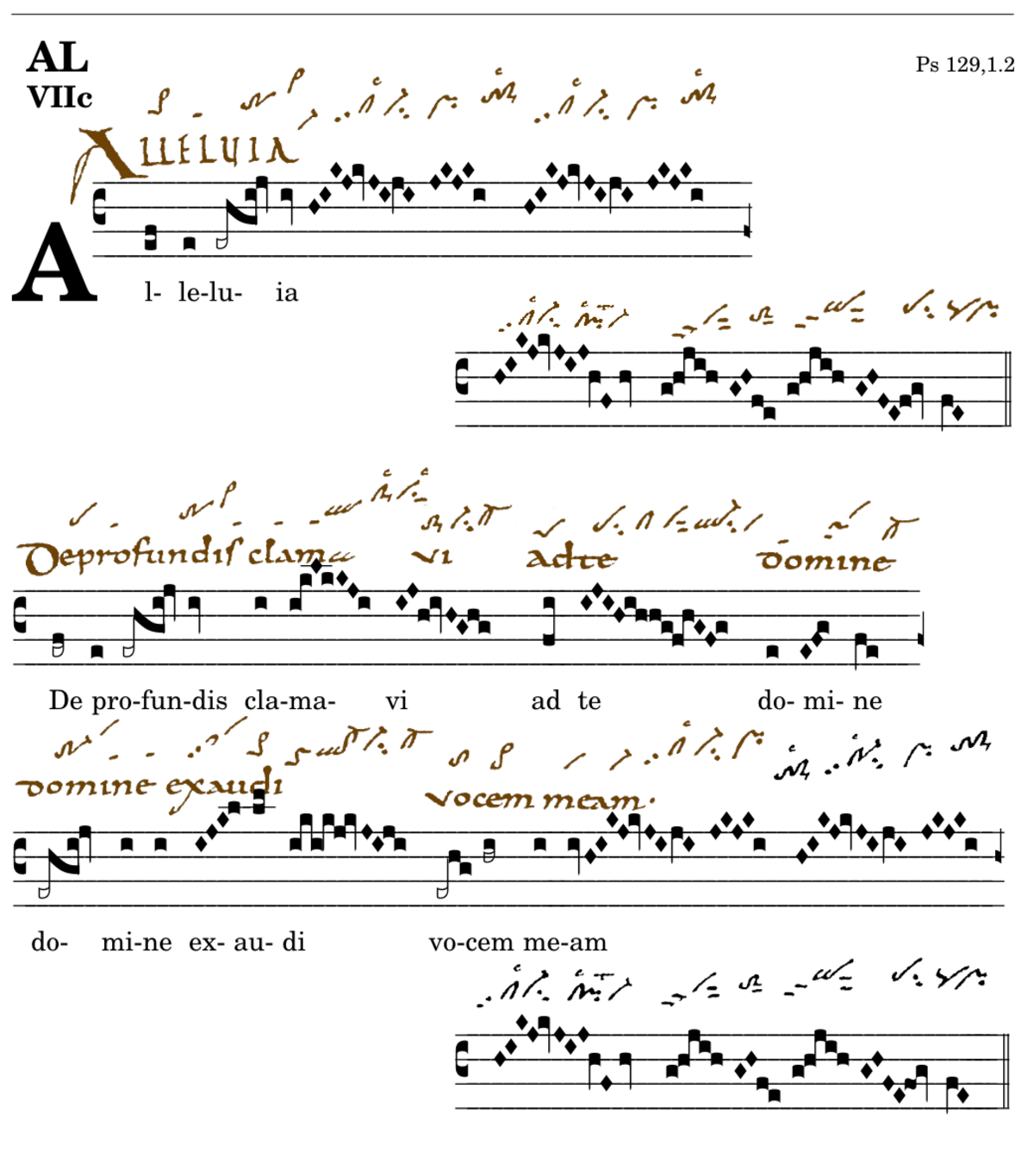
Im Sextuplex erscheint dieses Alleluia nur in C und K. Es muss daher vor 850 entstanden sein, nicht jedoch vor 800, da es R nicht kennt. Eine reife musikalische Komposition aus dem Ende der Karolingerzeit (753 - 840/70) mit sehr langem Jubilus.
Nur drei Elemente machen dieses Stück aus:
• Ein Incipit, das mit Torculus resupinus den Tonraum des 7.Modus eröffnet, das Wort „alleluia“ liegt darauf. Ebenso werden damit die Textanfänge der beiden Verszeilen versehen. Ein
• Melisma 14tönig/stufig, das zweimal wiederholt wird „do zum re“, bei der zweiten Wiederholung wird es verkürzt und zum „la“ geführt. Ein weiteres
• Melisma 9tönig/stufig, das bei der Wiederholung in die klassische Schlussformel des 7.Modus geführt wird.
bisher unvertont bleiben nur die Texte: „…clamavi ad te domine“ und „exaudi“.
V. Aus der Tiefe rufe ich, Herr, zu dir / Herr, höre meine Stimme.

V. From the depths I call to you, Lord / Lord, hear my voice.
In the Sextuplex, this Alleluia appears only in C and K. It must therefore have been composed before 850, but not before 800, as it does not appear in R. A mature musical composition from the late Carolingian period (753–840/70) featuring a very long Jubilus.
This piece consists of just three elements:
• An incipit which opens the tonal range of the 7th mode with a Torculus resupinus; the word ‘alleluia’ is set to this. The beginnings of the two verse lines are likewise set to this. A
• 14-note/step melisma, which is repeated twice ‘do to re’; on the second repetition it is shortened and led to ‘la’. A further
• 9-note/step melisma, which, upon repetition, leads into the classical closing formula of the 7th mode.
The only texts remaining unset to music are: ‘…clamavi ad te domine’ and ‘exaudi’.