Dies ist eine alte Version des Dokuments!
🔘 IN GR TR AL OF CO xxxxx ✅ 2️⃣ 3️⃣ 4️⃣ 5️⃣ 6️⃣ 7️⃣ 8️⃣ xxxxx AN RP IV alia
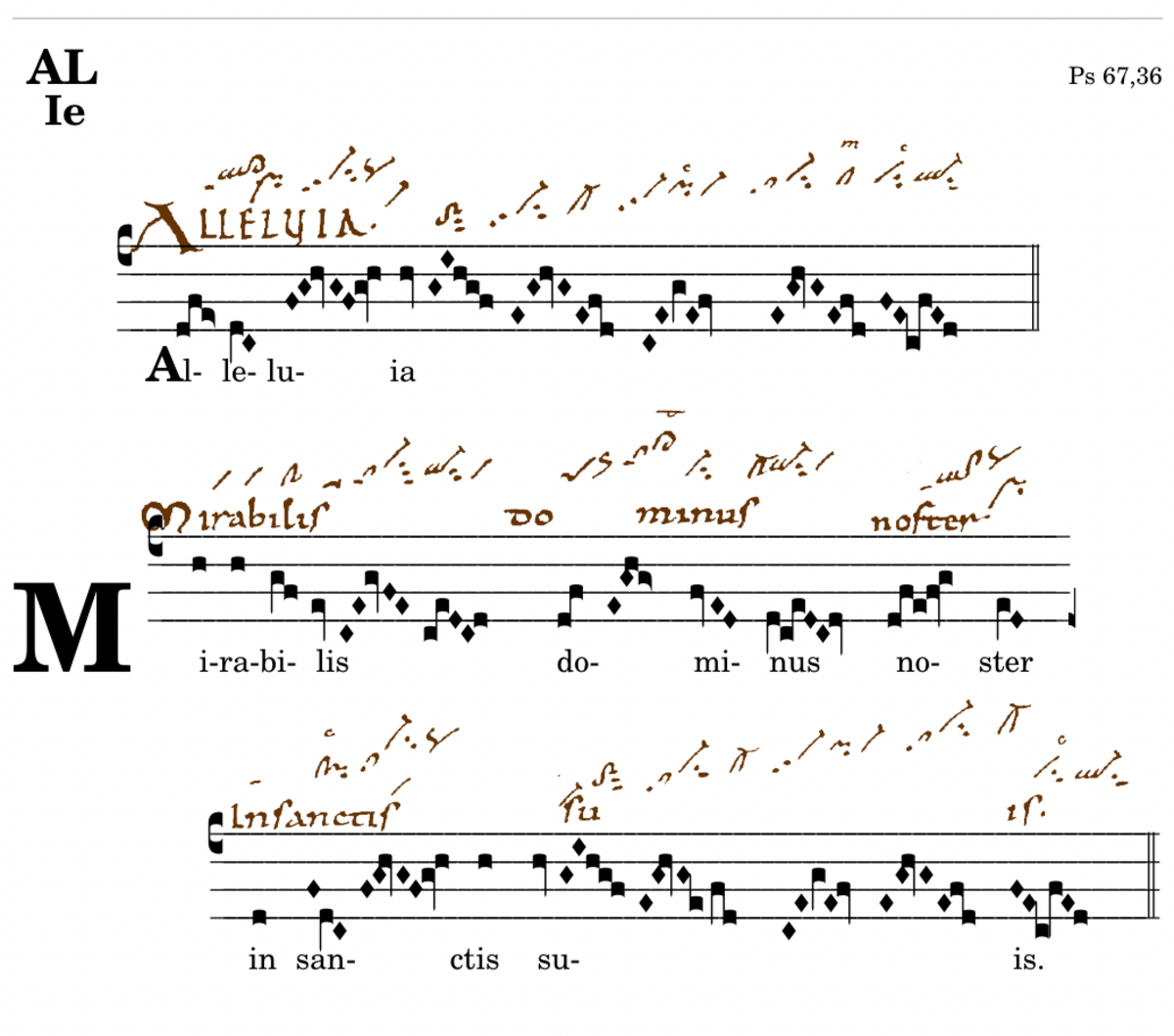
0384 AL Mirabilis dominusModus 1e
0380 ⟽ AL 1 ⟾ 03881367 ⟽ AL 1e ⟾ 1346xxx ⏹️xxx GT 462 - GN 2/175 - BzG 31/24 - SX ….CS
SI - SA „Allelu-ia“ Kl schreibt „sa“, trotzdem ist „si“ nicht nur denkbar sondern wahrscheinlich. Bevor das tritonale „fa“ erreicht wird, bezieht sich das „si“ auf „la“ und „sol“. Ebenso ist die reine Quint „si-mi“ vorherrschend. Überhaupt ist in diesem AL des 1. Modus die Ebene „mi“ stark präsent („Mirabi-lis“). Trotz Zt und Kl kein Grund „sa“ zu singen.
Die Repetenda verwendet den ganzen Iubilus. Der kurze Vers spielt zweimal an Formeln des Iubilus an „Mirabi-lis do-minus“. Zu beachten ist die ScaFlex… Bewegung „mi-sol-la-sol…“ des Iubilus, die im Vers durch Liqueszenz zum ScaFlx verkürzt ist („do-minus“).
V. Wunderbar ist unser Gott
in seinen Heiligen.

V. Wonderful is our God in his saints.
SI - SA ‘Allelu-ia’ Kl writes ‘sa’, yet ‘si’ is not only conceivable but probable. Before the tritone ‘fa’ is reached, the ‘si’ relates to ‘la’ and “sol”. Likewise, the perfect fifth ‘si-mi’ is predominant. In general, the ‘mi’ level is strongly present in this AL of the 1st mode (‘Mirabi-lis’). Despite Zt and Kl, there is no reason to sing “sa”.
The Repetenda uses the entire Iubilus. The short verse alludes twice to formulas of the Iubilus: ‘Mirabi-lis do-minus’. Note the ScaFlex… movement “mi-sol-la-sol…” of the Iubilus, which is shortened in the verse through liquefaction to ScaFlx (“do-minus”).