Dies ist eine alte Version des Dokuments!
🔘 IN GR TR AL OF CO xxxxx ✅ 2️⃣ 3️⃣ 4️⃣ 5️⃣ 6️⃣ 7️⃣ 8️⃣ xxxxx AN RP IV alia
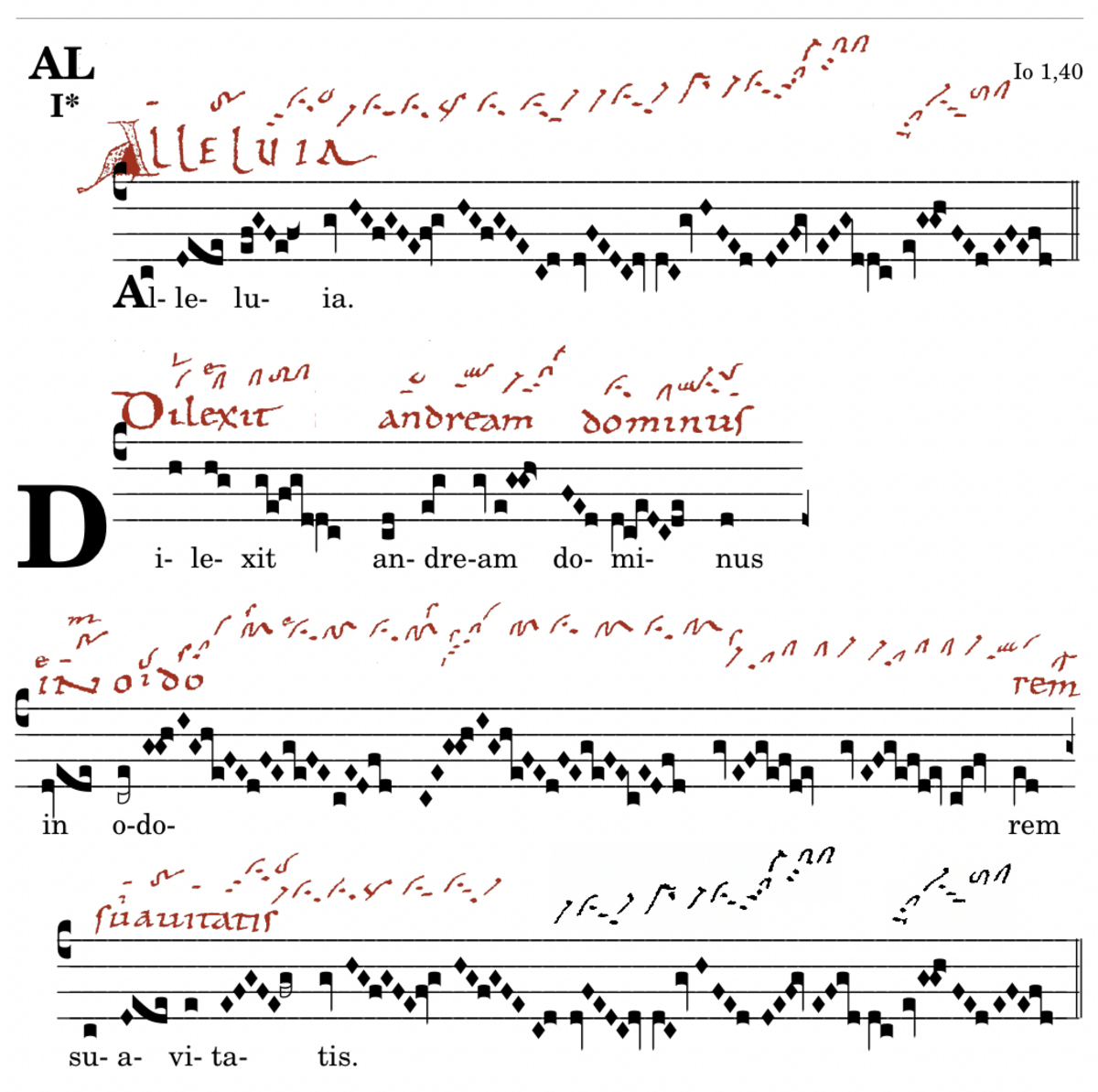
0325 AL Dilexit andreamModus 1*
0308 ⟽ AL 1 ⟾ 03281812 / 1410 / 3569 ⟽ AL 1* ⟾ 0370 xxx ⏹️xxx GT 413 - GN 1/387 - BzG 37/22 - Sextpl ……
 Das AL wurde im 10. Jahrhundert, nicht vor 900 komponiert, denn es steht noch nicht im SX (Graduale/Antiphonale missarum Sextuplex) Das bestätigt auch die Struktur:
Der gesamte lange Iubilus wird als Repetenda eingesetzt (ab „suavitatis“). Der
Jubilus wiederholt und variiert eine 8(9)-tonige Formel A und schließt mit einer verkürzten Variante ab AAa Darauf folgt eine 15-tonige Formel B, die verkürzt wiederholt wird und auch den Kern des
Vers-Anfangs bildet „Dile-xit andre-am domi-nus“ BB - BB .
„in odo-rem“ folgt ein 23-toniges Melisma, das wiederholt wird CC und eine umittelbar anschließende 8-tonige Formel D, ebenfalls wiederholt DD.
„Dile-xit“ 🍏 L, A, Kl - 🍎 E, Bv, Y, Kl.
„o-do-rem“ „si-be-durum“ reine Quint zum „mi“, Kl „do“. In E 'sursum'.
V. Der Herr liebte Andreas / wie beruhigenden Duft.

V. The Lord loved Andrew / like a soothing fragrance.
The AL was composed in the 10th century, not before 900 (as it does not yet appear in the Sextuplex). This is also confirmed by the structure:
The entire long Iubilus is used as a Repetenda (from ‘suavitatis’). The
Jubilus repeats and varies an 8(9)-note formula A and concludes with a shortened variant AAa This is followed by a 15-note formula B, which is repeated in a shortened form and also forms the core of the
vers opening “Dile-xit andre-am domi-nus” BB - BB .
‘in odo-rem’ is followed by a 23-note melisma, which is repeated CC, and an immediately following 8-note formula D, also repeated DD.
‘Dile-xit’ 🍏 L, A, Kl - 🍎 E, Bv, Y, Kl.
‘o-do-rem’ ‘si-be-durum’ perfect fifth to “mi”, Kl ‘do’. In E “sursum”.