🔘 IN GR TR AL OF CO xxxxx ✅ 2️⃣ 3️⃣ 4️⃣ 5️⃣ 7️⃣ 8️⃣ xxxxx AN RP IV alia
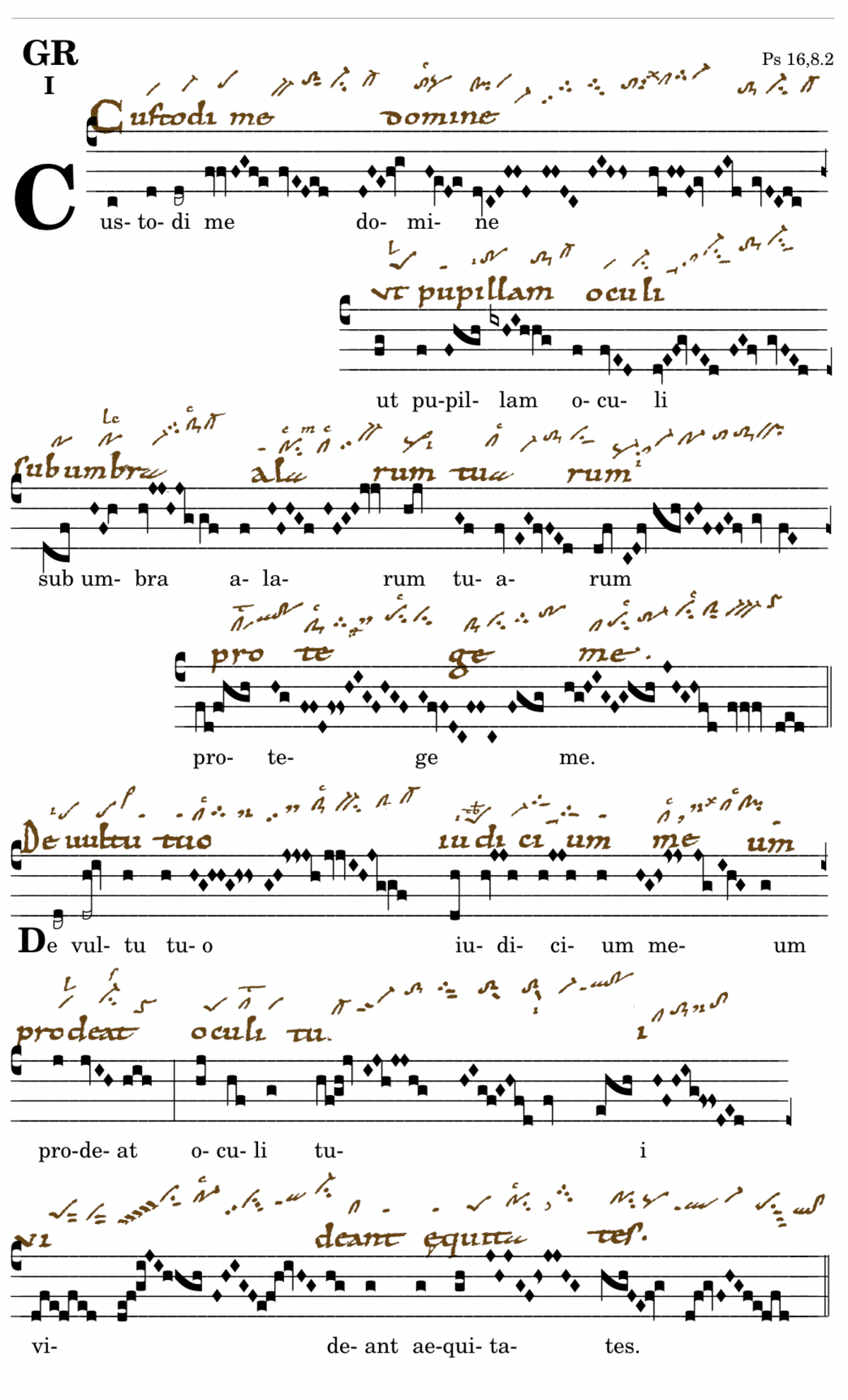
0191 GR Custodi meModus 1
0174 ⟽ GR 1 ⟾ 0205 xxx ⏹️xxx GT 304 - GN 1/285 - BzG 41.42/23
GR1 INC
GR1 MED
GR1 NOV
GR1 TER
GV1 INC
GV1 MED
GV1 NOV
GV1 TER
„Cus-tó-di mé-“ In L ist die erste Silbe eindeutig tiefer als die zweite („do - re“), während MR und Ch ebenso eindeutig zwei gleich hohe Töne notieren („re - re“), ebenso die frühen diastematischen Quellen A+Y und Bv uns alle späteren bis zu GR und GRn.
Die St.Galler Tradition mit ihrer sehr unvollkommenen Diastemie ist hier entscheidend, aber schwierig zu deuten: C, und Bam können als „do-re“ gelesen werden, ebenso vielleicht G374 und G342. Hingegen sind die beiden Virgen in G339 und G376 gleich hoch. Das Argument, ein tiefere Ton müsste ein Tractulus sein, kommt nicht zum Tragen, „Custodi“ ist das Morphem und ist daher auch als tieferer Ton eine Virga. Trotzdem bleibt „Custódi“ der grammatikalische Akzent, daher auch in C ein Episem. Die Endsilbe „Custo-di“ ist Binnensilbe daher der kPes; die folgende Bivirga „Custodi me“ ist der Hauptakzent.
Die Situation ist wie folgt zusammenzufassen:
„do-re“ ist die ursprüngliche, fein ausgewogende Form, die in der westfränkischen Tradition aber zugunsten einer flüssiger und leichter zu singenden Form aufgegeben wird. L ist hier nicht als westfränkisch zu verstehen, sondern als lothringisch (Saulnier) einer mittleren Tradition zuzuordnen. Die Entscheidung für „do-re“ stützt auch die Handschrift Mi (9.Jh) die für die erste Silbe eine Art Häckchen notiert, einen Tractulus mit Abstrich (Virga) korrigiert; oder ist es eine kürzere Virga mit Episem?
Behüte mich, Herr, wie den Stern des Auges!* Unter dem Schatten deiner Flügel
beschütze mich.
V. Von deinem Antlitz gehe das Urteil über mich aus,* deine Augen mögen Recht sehe

Protect me, Lord, like the star of the eye* Under the shadow of your wings, protect me.


V. From your face let judgement come upon me,* May your eyes see right.
“Cus-tó-di mé-” In L, the first syllable is clearly lower than the second (“do - re”), while MR and Ch also clearly note two tones of equal pitch (“re - re”), as do the early diastematic sources A+Y and Bv and all later sources up to GR and GRn.
The St. Gall tradition with its very imperfect diastemia is decisive here, but difficult to interpret: C and Bam can be read as “do-re,” as can perhaps G374 and G342. In contrast, the two virgens in G339 and G376 are of equal pitch.
The argument that a lower tone must be a tractulus does not apply, as “Custodi” is the morpheme and is therefore also a virga as a lower tone. Nevertheless, “Custódi” remains the grammatical accent, and therefore also an episem in C. The final syllable “Custo-di” is an internal syllable and therefore the kPes; the following bivirga “Custodi me” is the main accent.
The situation can be summarized as follows:
“do-re” is the original, finely balanced form, which is abandoned in the West Frankish tradition in favor of a more fluid and easier to sing form. L is not to be understood here as West Frankish, but as Lorraine (Saulnier) belonging to a middle tradition. The decision in favor of “do-re” is also supported by the Mi manuscript (9th century), which notes a kind of check mark for the first syllable, a tractulus with a downward stroke (virga) corrected; or is it a shorter virga with episem?