🔘 IN GR TR AL OF CO xxxxx 1️⃣ 2️⃣ 3️⃣ 4️⃣ 5️⃣ 6️⃣ ✅ 8️⃣ xxxxx AN RP IV alia
0545 OF In die solemnitatisModus 7?
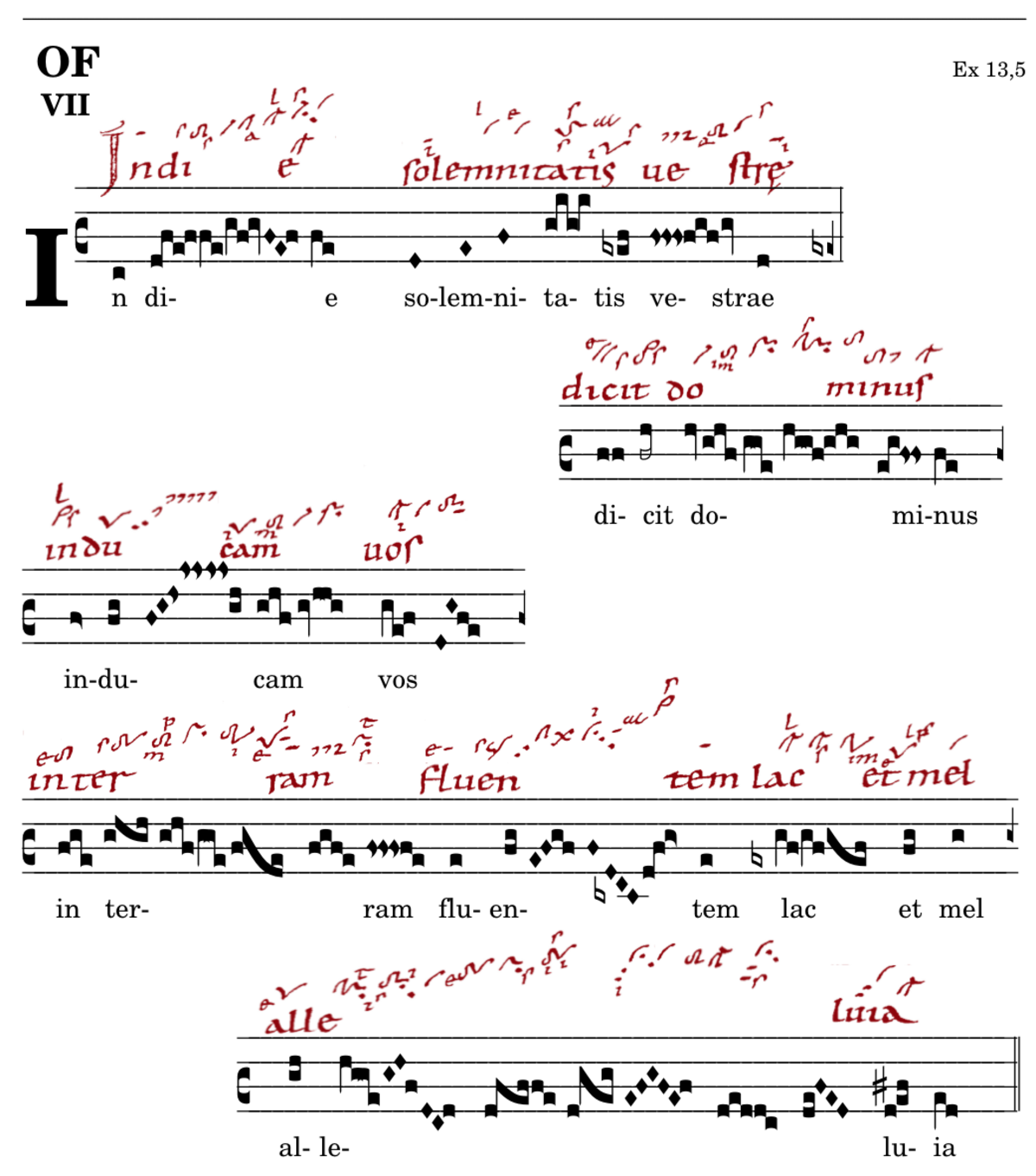
OF – V1 – V2 xxx ⏹️ xxx GT 210 - GrN 1/182 - BzG 48/30„di-cit dominus“ L und die Reduktion des kPes auf einen Ton in Ch, A, Y, sprechen gegen das erste 'sursum' in E. Die FML alloq in E (+Bv) betont „dicit dóminus“, L, Ch, A+Y hingegen betonen „dí-cit dominus“. Dafür spricht auch die Bivirga „dí-cit“, im Kontext eine durchaus sinnvolle Betonung. Aus der Liqueszenz in A+Y ist kein absteigender Liqueszenztzon zu lesen.
Am Tag eures Festes,
spricht der Herr,
werde ich euch
in ein Land führen, das von Milch und Honig fließt.
Halleluja.

On the day of your feast, says the Lord,
I will lead you to a land flowing with milk and honey.
Hallelujah
‘di-cit dominus’ L and the reduction of the kPes to one tone in Ch, A, Y speak against the first “sursum” in E. The FML alloq in E (+Bv) emphasises ‘dicit dóminus’, whereas L, Ch, A+Y emphasise ‘dí-cit dominus’. This is also supported by the bivirga ‘dí-cit’, a perfectly sensible emphasis in the context. Of the liquescence in A+Y, no descending liquescence tone can be read.