🔘 IN GR TR AL OF CO xxxxx 1️⃣ 2️⃣ 3️⃣ 4️⃣ 5️⃣ 6️⃣ 7️⃣ ✅ xxxxx AN RP IV alia
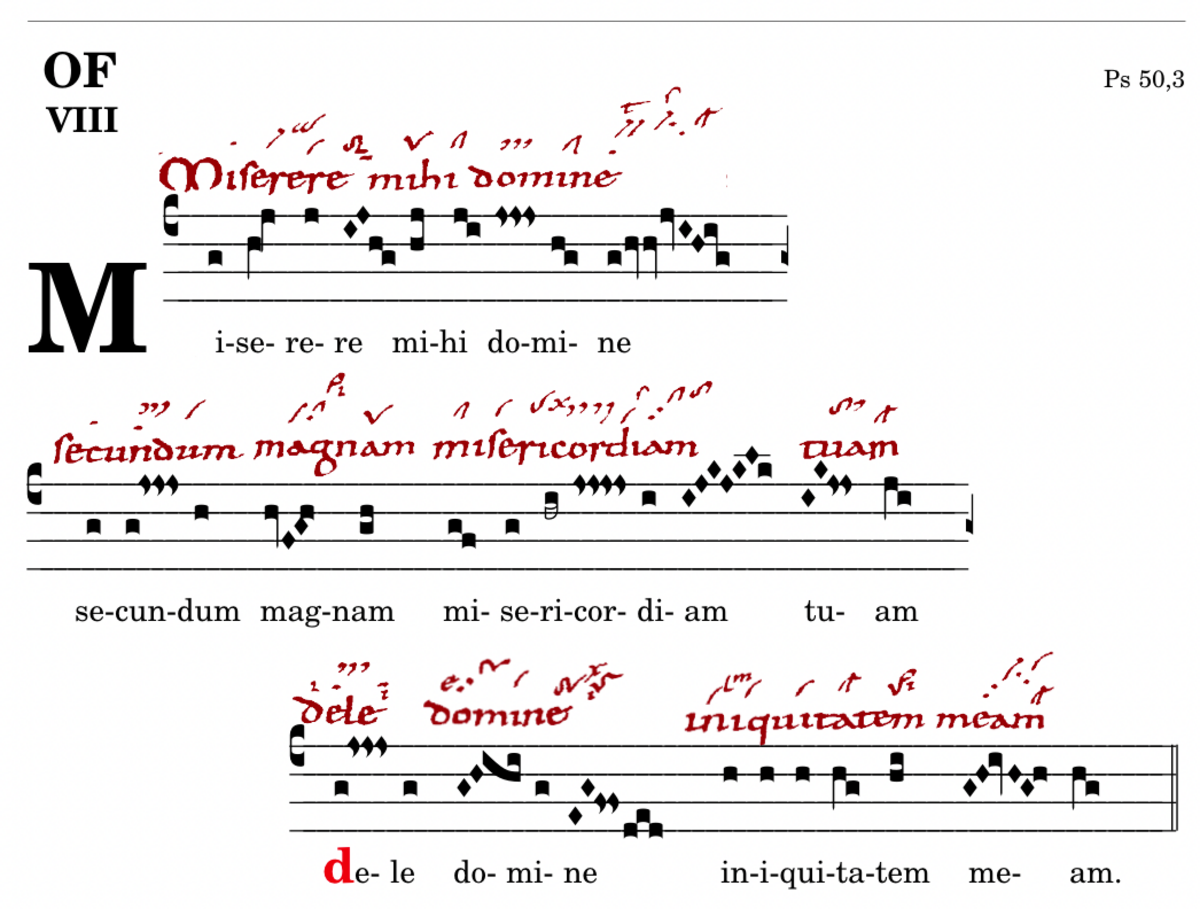
0567 OF Miserere mihiModus 8
OF – V1 – V2 xxx ⏹️ xxx GT 92 - GN 2/46 - BzG 54/40
 „domi-ne secundum“ Der Korrektur in BzG 54/40 ist insofern zuzustimmen, als die erste der drei Virgen tiefer sein muss. als die zwei folgenden. GR und Bam (!) sind hier bereits der „do-Revision“ gefolgt, wie auch schon A + Y + Bv33 und vor allem auch Ch(!).
Warum hier aber ein „fis“ im Spiel sein soll, ist aus den adiastematischen Quellen nicht belegbar, aus den diastematischen ohnehin nicht. Tractulus in E und G339 muss am melodischen Tiefpunkt nicht tiefer sein als der Ton zuvor. E, G339, Ch, L geben in keiner Weise zu erkennen, dass der erste Ton der Silbe „-ne“ tiefer sein sollte als der letzte Ton der Silbe „-mi-“. Die Lösung a) „sol-la-la“ für den Einstieg in die Neume „domi-ne“ ist ebenso möglich wie die Lösung b) „fa(si-be-durum)-sol-sol“. Für b) spricht lediglich das sursum in E, dem aber sonst nicht entsprochen wird, auch nicht in L. Ein Problem das (vorläufig?) nicht eindeutig lösbar ist.
Erbarme dich meiner, Herr / in deinem großen Erbarmen,\\
lösche aus, Herr / meine unrechte Tat.

Have mercy on me, Lord / in your great mercy,\\
blot out, Lord / my unrighteous deed.
„domi-ne secundum“ The correction in BzG 54/40 is to be agreed with insofar as the first of the three virgules must be lower than the two following ones. GR and Bam (!) have already followed the „do revision“ here, as have A + Y + Bv33 and, above all, Ch(!).
But why an „f sharp“ should be involved here cannot be proven from the adiastematic sources, and not from the diastematic ones anyway. Tractulus in E and G339 does not have to be lower at the melodic low point than the note before. E, G339, Ch, L do not indicate in any way that the first note of the syllable „-ne“ should be lower than the last note of the syllable „-mi-“. The solution a) „sol-la-la“ for the beginning of the neume „domi-ne“ is just as possible as the solution b) „fa(si-be-durum)-sol-sol“. The only argument in favour of b) is the sursum in E, but this is not otherwise met, not even in L. A problem that (for the time being?) cannot be solved unambiguously.